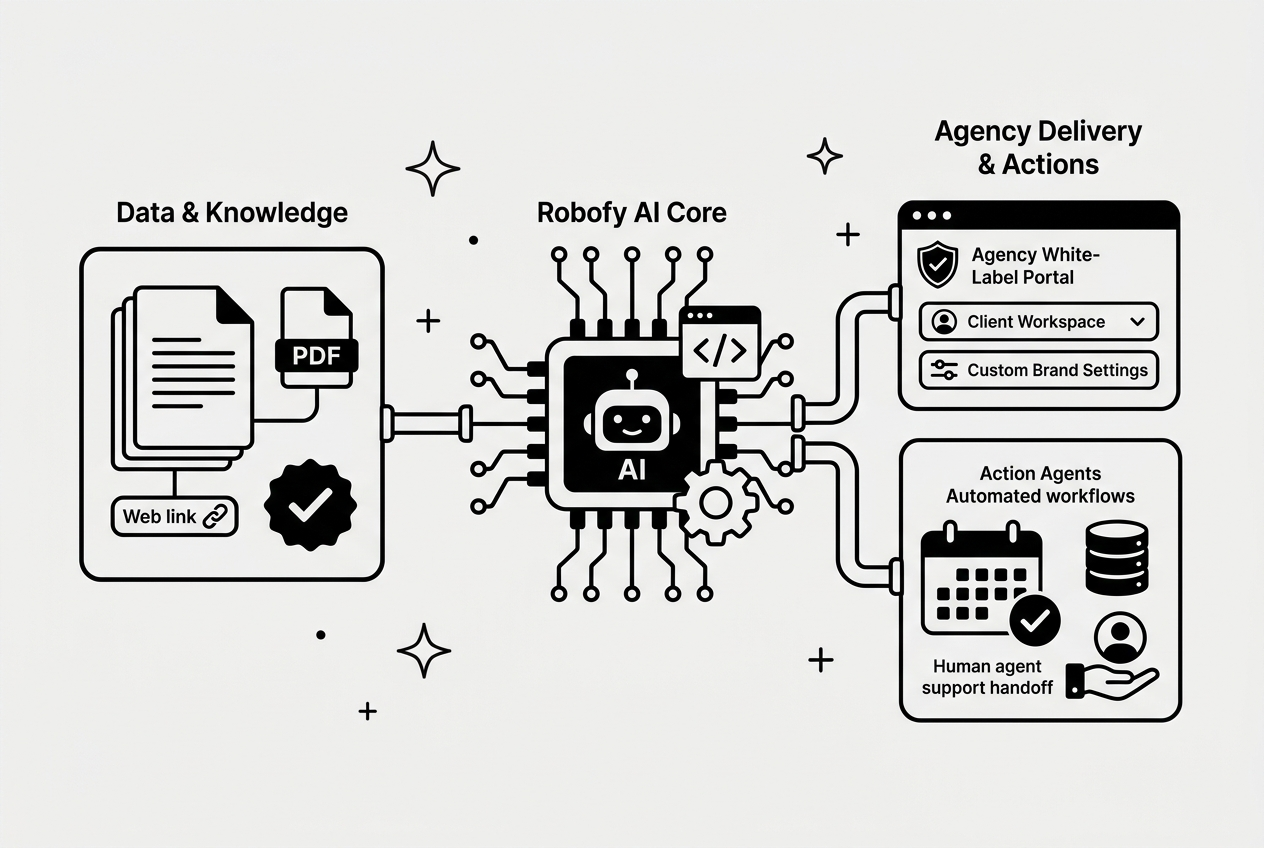
We built Robofy to give agencies a conversational AI platform they could brand and offer to clients. The agency would manage the relationship and the service; the platform would provide the software behind it.
That required more than an assistant that could answer questions. Agencies needed a way to organize client information, manage separate accounts, use their own branding and handle what happened after a customer asked for help.
The Robofy white label chatbot offering brings those requirements together. The reasons behind them explain the kind of service we want agencies to be able to deliver.
1. Business questions need business information
A customer rarely phrases a question exactly as it appears in an FAQ. They may ask about several things in one message or return with a follow-up that depends on the previous answer.
Scripted menus remain useful for defined tasks. Questions about a particular business also need a way to find the relevant information and explain it in the customer’s terms.
That was the problem we wanted Robofy to address. If the published cancellation policy requires 48 hours’ notice, the answer should reflect that policy. If the available information does not explain an exception, the conversation needs a way to involve the team.
Fluent wording alone cannot establish whether an answer is correct. The source and the follow-up matter to the person asking the question.
2. Agencies need software they can operate for clients
An agency already knows a client’s services, positioning and sales process. It may maintain the website and prepare the campaigns that bring people to the business.
We wanted that understanding to carry into customer conversations without requiring the agency to build an entire software platform. The agency could prepare the information, define the service and review its results while using Robofy for the underlying conversational tools.
Account management then becomes part of the product requirement. An agency needs to find a client’s configuration, update its information and understand an open request. Those tasks continue long after the first demonstration.
3. Knowledge and connected actions need different treatment
Robofy supports business knowledge drawn from website content and selected documents. That gives agencies a way to prepare answers from material the client can review and maintain.
Connected actions address another need. A published policy can explain how booking works, but checking a current slot or retrieving an order requires access to the relevant system.
Our white label AI agents cover three kinds of work:
- The Support Agent answers questions using the client’s approved information.
- The Lead Agent collects enquiry details and helps qualify the customer’s needs.
- The Action Agent carries out configured tasks through connected business systems. Appointment booking belongs here, alongside tasks such as order lookups or account updates.
For an illustrative booking workflow, the agent would need a connection that can check availability and submit the booking. Collecting a preferred date produces a request; the connected system must return a successful result before the agent can confirm an appointment.
What an agent can do depends on its tools, permissions and the business systems available to it.
That creates a practical choice for agencies. Start with answers and lead capture if the client has no suitable system connection. Add an Action Agent when the required access, permissions and failure handling are ready to test.
Security is also part of the evaluation. Our Trust Center documents the ISO/IEC 27001 certification, privacy information and protection of data in transit and at rest. Agencies should review those materials alongside the permissions and data their proposed service needs.
4. The agency and the platform each have work to do
Adding an AI assistant to a marketing service creates ongoing responsibilities. Someone needs to approve the client’s answers, check conversations and make sure requests reach a person who can act.
The platform provides the tools for building and running the configured conversation. The agency decides how those tools fit the client’s work, and the client’s team remains responsible for decisions the service has not automated.
An assistant may help a visitor arriving from a search result, a landing page or a WhatsApp campaign. Measure what happens next: whether the question was answered, whether an enquiry reached the right team and whether a requested task completed. Use the client’s own results when evaluating any effect on sales.
That division of responsibility should be clear in the proposal and in the team’s operating process.
5. Branding and client workspaces belong together
White label branding lets an agency present its own service through a supported logo, colors and custom domain. Clients know which company they are buying from and where to ask for help.
Separate client workspaces address another requirement: different businesses have different documents, people and conversation histories. Agencies need to manage those environments without mixing the information used by each assistant.
Branding and account management therefore belong in the same offering. A branded portal needs practical controls behind it so the team can maintain what it sells.
The agency should still explain the relevant suppliers and data handling to clients. Using its own brand does not remove those responsibilities.
6. Follow-up is part of the product
An answered question may finish a conversation. An enquiry or request for a person needs somewhere to go.
Robofy provides lead capture, human-support requests and webhook events that a connected workflow can process. A webhook passes an event to another system; the receiving application still needs to create the CRM record or follow-up task.
This is why handoff needs to be demonstrated alongside answers. Check the notification destination, the summary and the customer’s chosen contact route. Robofy’s human handoff guide describes a request for team follow-up, with the AI able to continue helping. Test the intended channel before promising a live takeover.
A useful handoff process lets the team pick up the request without asking the customer to explain everything again. It still needs a responsible person and an agreed response time.
7. The reseller plan and the agency’s service price are separate
We designed the reseller offering so agencies could set their own client prices. The platform plan provides capacity and tools; the agency’s price also has to cover its delivery work.
Shared AI credits let usage sit within an agency allocation. They still need to be monitored. A client with frequent conversations or source updates may use more capacity than another client.
Review the current reseller pricing against the clients and services you intend to support. Keep the software, messaging, integration and labor costs visible when deciding what to charge.
The agency can then price a defined service: which topics it maintains, which actions it supports and how often it reviews conversations. Include sales costs, support work and overhead when assessing the margin.
8. Maintenance and limits need to stay visible
Business information changes. An agency needs a way to replace an old policy, identify the affected assistant and check the new answer. Keeping the source current is part of the service it provides.
Human follow-up needs the same attention. Staff contacts change, inboxes go unchecked and a request may remain open. Review where the process failed before assuming that the answer generation caused the problem.
Keep new deployments focused enough to test. Extra channels, live-system actions and complex routing each add work to configure and support. Agree on a useful first scope, review its results and decide what to add from there.
These are operating requirements agencies should examine in any reseller platform, including ours.
9. Review the offering against your own client work
If you are considering Robofy, bring a client’s approved information and a set of questions to the evaluation. Follow an enquiry through the answer, capture and human-support steps you intend to offer.
Check how your team would update that client’s information and manage the account after launch. Use the demonstration to identify both the useful capabilities and the work still required.
Explore the Robofy white label chatbot offering with that service in mind, review the current plan allowances and test the complete client journey before making a commitment.